
The things we keep
Why do our possessions mean so much to us?

I saw a photo today of a house ablaze and recalled a post by the writer Bridgett Davis on the material things that inhabit our lives. She had considered the loss of belongings as we all watched monster wildfires burn parts of Los Angeles to the ground. “Things that outlive our loved ones don’t always outlive us,” she wrote.
I’ve been thinking about that line ever since.
Ah, possessions. Our prized possessions. And others, less so. The objects we deliberately keep and others that get stuffed into drawers, packed into boxes, smushed into the backs of closets that, no matter how spacious, seem never to be large enough to hold everything.
Guilty. Yes, I own many things that fall into that second category. Things that are not so dear to me and yet, I simply cannot throw away. Somewhere in my brain I know that I will never really need the CamelBak water reservoir that I once used as a war reporter in Iraq. Or the set of plastic popsicle sticks that I thought I could repurpose for uh, I’m not sure what. Or the worn Egyptian cotton bedsheets that once were crisp and white and now are scratchy and thin and the color of sand. I might need them as drop cloths one day when I paint my house. Never mind that I will probably hire a professional.
Even though the closets of my 1924 bungalow are small and bursting with things, they are not vast repositories of memories.
My father was a refugee when India was partitioned and his family started life anew in Kolkata, minus many of the things that warmed their house on Bakshibajar Lane in the city that is now the capital of Bangladesh — Dhaka. He never pined for possessions. He was a simple man with simple tastes and he tried to mold us by example.
The one thing Baba savored was travel and my formative years were spent traipsing across the globe, living in rented houses, attending a wide array of schools in several countries. I cherish those experiences and have come to realize the critical role they played in shaping me not just as a journalist but as a human being.
On a practical level, the constant moving meant two things. I had to find ways to assimilate no matter where I was. That’s a hard thing when you are a kid and all you want is to not stick out in the crowd. It also meant that every year or if we were lucky, two, we left the house we called home to begin again elsewhere with little but the few things in our suitcases.
I don’t have any of my childhood clothes or toys, save a handful of broken Barbie dolls. I have only a few of my grade school writing notebooks and report cards with the stars by my English classes. The teachers’ remarks about my enthusiasm for English prompted my father to buy me books to encourage my writing. Dickens, Austen, Chekov, Dostoyevsky. I stayed up late in the dim light of an Eveready flashlight to read and savor every word. I remember the smell of their leather covers more vividly than I remember where they went.
I don’t have those books anymore. Nor can I return to a childhood bedroom brimming with trophies and awards. Or souvenirs from special moments. I don’t have household hand-me-downs like vintage Wedgwood China sets. Or pristinely folded and boxed linens that would fetch a pretty penny at an antique store. I envy my friends who have those kinds of family heirlooms, treasures from their parents or grandparents that they savor and keep to pass onto their own children and grandchildren. Well, I don’t even have children.
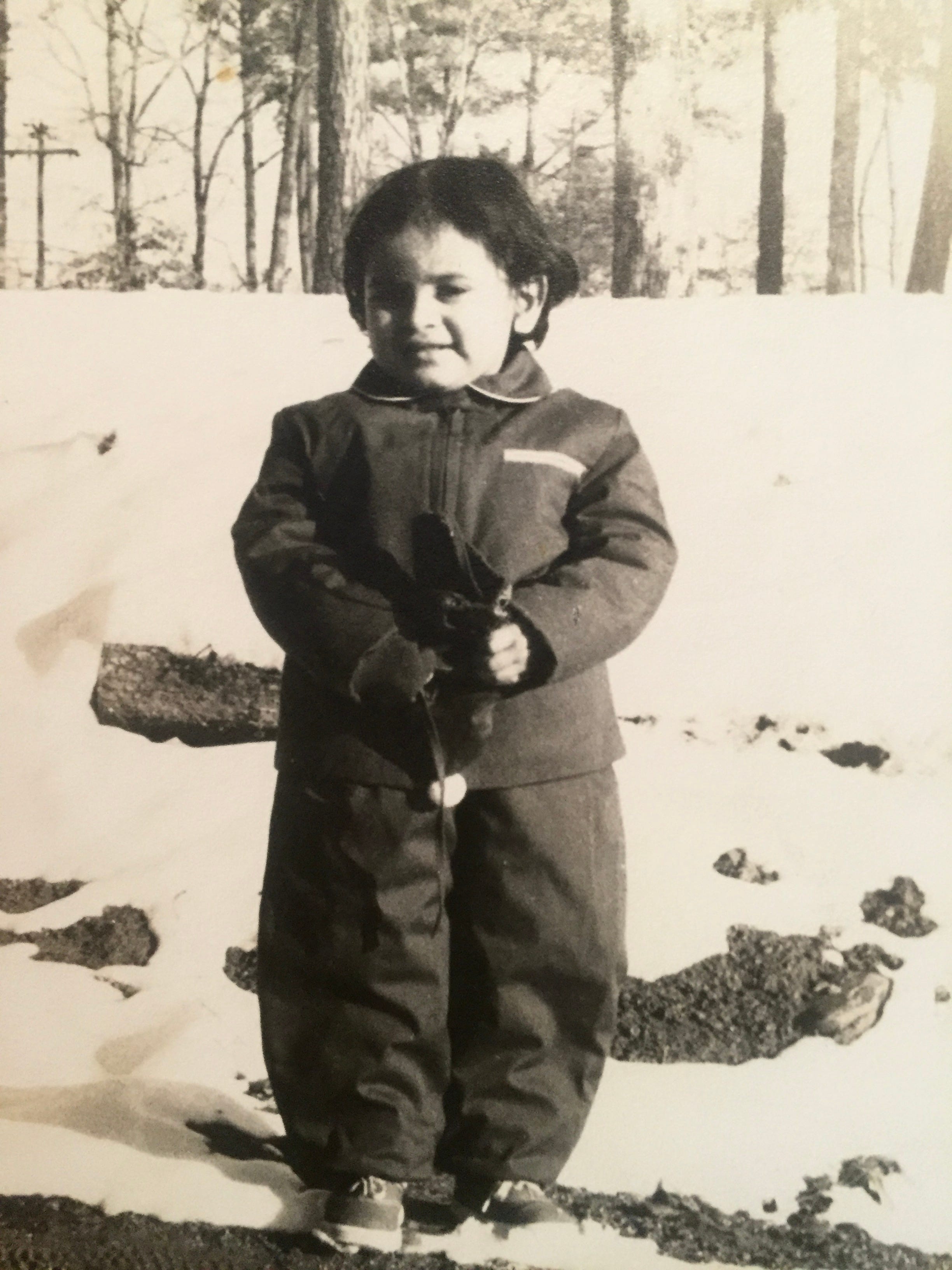
What I do have are photographs of certain periods of my life. My father was rather enthusiastic about photography at the time I was born. Somewhere on his travels, he bought an imitation Rolleiflex camera and experimented with different kinds of filters. Amazingly, that camera is one of the things that has managed to stay with me over the years, intact in its red velvet-lined case with four different filters tucked into leather pouches. The camera no longer works but I cannot part with it. Without it, so much of my life would have remained undocumented: my travels with my parents across the Middle East and Europe, my first major snowstorm in Chicago (above), my best friend Zina at Beaver Road Junior School in Manchester, England. The camera did not just capture images; it preserved proof that those moments existed at all. I can tell when my father’s eyesight began declining — he suffered from macular degeneration in both eyes — because fewer photos exist of my teenage and college years.
I wish I could say I owned the kinds of things that Davis wrote about, the things that are irreplaceable. I have never lost everything in a fire; I cannot imagine what it feels like to watch helplessly as every last possession bends and twists and melts until they are reduced to nothing but mountains of smoldering ash.
But sometimes, loss arrives without flames. It comes quietly, invisibly, even. It strikes like a fist to the gut, leaving no smoke, no spectacle, only absence.
A few years ago, I moved from Atlanta to Gainesville to start a teaching job at the University of Florida. It was a hectic move of the order that I had never encountered before. In the process, many things got tossed and a few things were stolen by the moving crew. Among them were two gold rings. They were precious to me.
The following year, I flew back from a long trip to San Francisco but my checked-in suitcase never made it out onto the baggage carousel at the Atlanta airport. I thought at first that the bag had been misplaced and I would get it back a few days later. But Delta lost it. It vanished. Most likely, it had been stolen because I had foolishly packed jewelry in it. I was traveling with my dog and wanted to lighten my carry-on load. I didn’t care that I had lost my clothes and shoes. Even the Bose noise-canceling headphones or expensive new jewelry. But I could never get back the pieces that belonged to my mother. Rings, earrings, necklaces. I sobbed for days. I felt that fist in my gut.
I thought about my stolen rings and my lost bag for weeks, months. It has been many years now, and I still wonder. Who took them? And what did they do with my things? The things that meant nothing to them except a few dollars. The things that meant everything to me. My mother’s things. I don’t have many such things and therefore, they were all the more precious.
Luckily, I still have a small diamond ring that Ma wore occasionally. The stone had once been set in a platinum band that my father bought for my mother in 1969 at a shop in the Coronado Shopping Center in Albuquerque, New Mexico. She wore that ring until her flesh swelled after a massive stroke and doctors ordered it cut off from her finger. Years later, Ma had the diamond reset in 22-karat gold in Kolkata and wore it to parties or on special occasions.
I wear that ring and imagine my hands to be hers, the hands that caressed my face and wiped away my fears.
I keep a box filled with the few possessions of my mother’s that have survived my many moves. Among them are a few of the block-printed caftans she wore after a stroke made it hard for her to drape her own saris and a Kashmiri chain-stitched shawl she wrapped around her on winter days in Kolkata when the inside temperature of our non-climate-controlled flat dropped rapidly with the chill outside. I also kept a pair of her bifocals that never sat straight on her face. And a lined school notebook purchased at The Metropolitan Book Stall on Park Street that Ma had filled with the addresses and phone numbers of anyone and everyone who meant something to her — from her brother to the man who owned a Park Circus frame and copy shop who had informed her he could supply her with instant passport photos. Some of the numbers were so old that they only had six digits, from days when working landlines in India were considered somewhat of a luxury.
These things I keep — they could be just material possessions of little value crowded into the dark corners of the few closets in my house. Except that they are things that outlived my mother. And so far, they have managed not to outlive me.
Beautiful and so true, Moni. When I moved into a very tiny house some years ago, I let go of a lot of things and it felt so freeing. The things I kept became more precious by the mere fact of me keeping them. And the things I cherish most now are objects that my parents treasured - my mother's rosary beads, my father's high school ring, an odd clock/tachometer set in wood that always sat on my father's dresser.
Lovely post, Moni. I've been winnowing things slowly. The hardest to get rid of are things people gave me--especially people who are no longer with us. But I am trying to keep one or two things and let the others go. We want our things to be special, but we want to own them--we don't want them to own us. I'm so glad you have those photos, and I am still sorry about that stolen jewelry. If you let things go it should be your choice, not the choice of thieves.